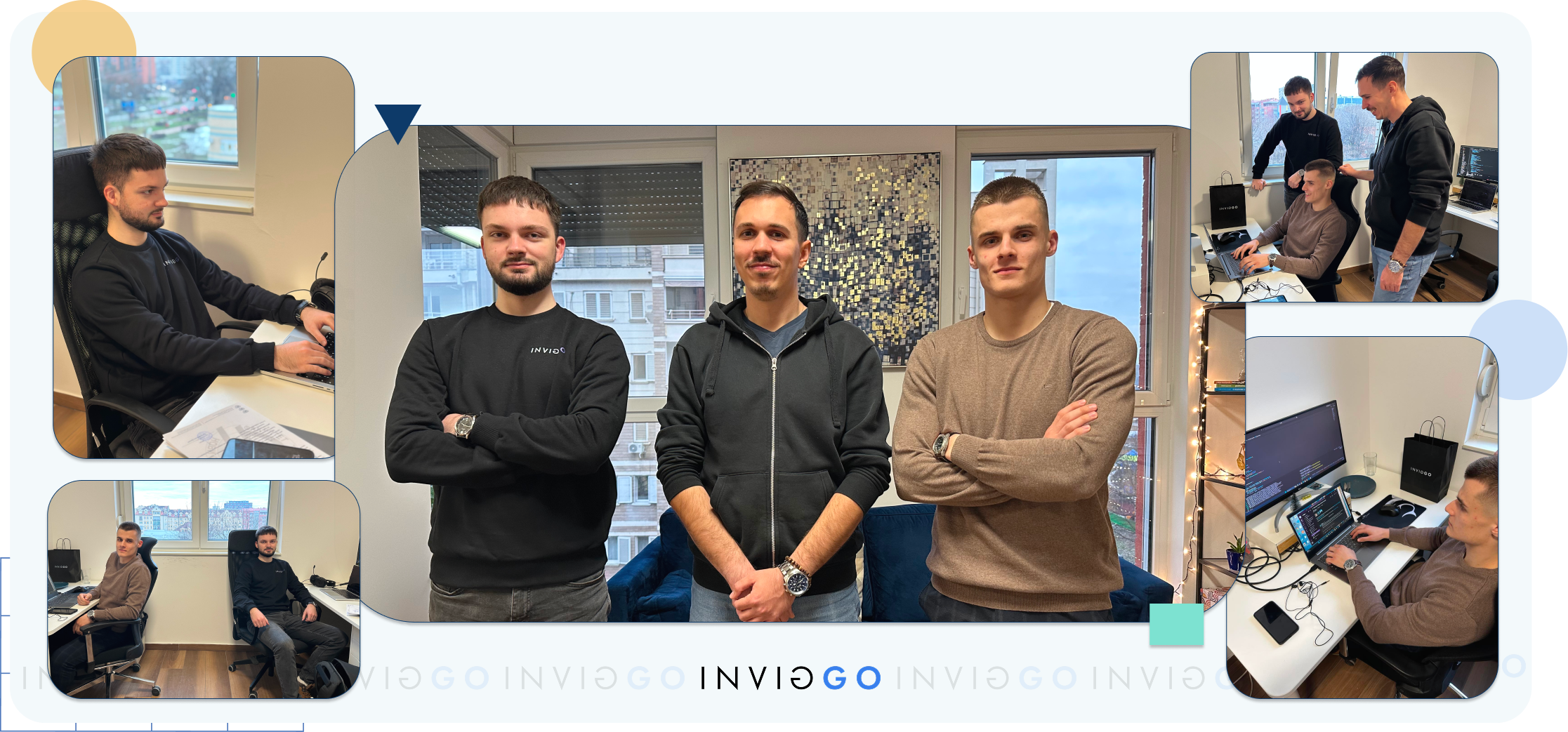
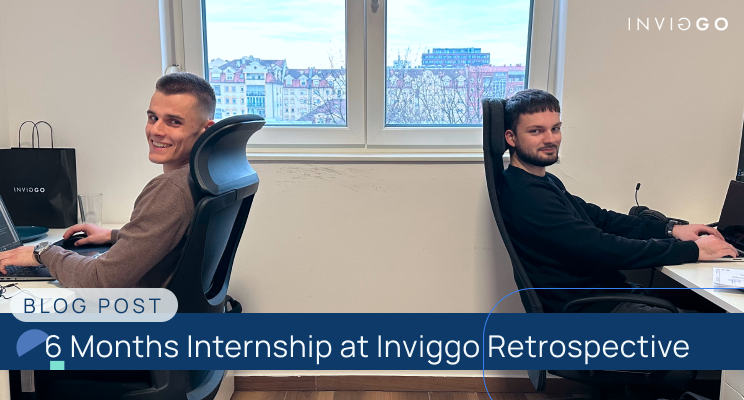
Six months ago, the Inviggo team became richer with two unique minds - smart, university-educated, dedicated, and remarkably ahead of their time when it comes to technology. After making a strong impression during the preselection interviews, they joined our team and brought fresh energy, along with impressive speed in logical thinking and sharp problem-solving skills.
During the first two weeks, both interns were given time to meet the company culture, their team, and other employees, as well as the company’s working ethics. Although Inviggo operates under a hybrid model (in-office and remote), interns have been encouraged to spend more time in the office to build strong professional habits, foster collaboration, and develop a sense of responsibility from the start.
Their mentor was our Senior Developer, Nikola Savić, who guided them throughout the entire internship. The process was overseen by our CTO, Vladimir Dabić, who collaborated with them on the development of specific features and concepts. Check it out after you read about their interesting internship journey.
Worked on and contributed to the ongoing project - AFI manager.
A structured Microsoft Word–style document view displayed on the left-hand side, presenting financial report elements in a clear, report-like format.
This preview allows users to analyze financial data within a familiar document layout, while maintaining a structured breakdown of report components for efficient review and analysis.
Integrated graphical reporting components (charts and visual indicators) designed to support financial data analysis.
This feature enables dynamic visualization of key metrics, trends, and comparisons, improving interpretability and supporting faster, data-driven decision-making within the reporting workflow.
Allowing users to download tables, text, and charts to Excel, Word, and XML for further manipulation and reuse.
This capability enables seamless sharing, customization, integration with other systems, and extended analysis of report data outside the application.
During the process, the mentor focused on introducing Srđan to the project’s conventions, coding standards, styles, and development guidelines.
Based on his so far internship and engineering journey, Srđan is now ready for:

Worked on and contributed to the ongoing project - Selfnest.
Brainstormed and delivered functional, high-quality solutions for already existing, though pretty limited admin panel reports, integrating statistical analysis - metrics such as purchases, therapy renewals, percentage relation between new and renewed therapies, searches by client ID or therapists’ name, issued codes - all within customly selected calendar dates. Developed predefined filters necessary for marketing analysis, for later project management based on available statistical numbers.
This feature enhances performance reporting by enabling the dynamic visualization of key metrics and ongoing result comparisons, eliminating the need for manual reports and making it easier for clients to understand performance insights.
Resolved a key operational issue on the platform, improving reliability and workflow consistency.
This feature enabled faster, timely responses and made scheduling and rescheduling more flexible and user-friendly for the operational team.
A seamless system for uploading and previewing media files directly within the chat interface, leveraging Twilio messaging infrastructure.
This feature allows users to send, receive, and view files without leaving the conversation, enhancing communication efficiency and reducing reliance on external tools.
As part of an internal Proof of Concept initiative, Vladimir developed a Python-based system leveraging Retrieval-Augmented Generation (RAG) to enable natural language interaction with the company’s reporting data.
The goal was to allow non-technical administrators to generate complex analytical insights simply by asking questions in plain language, while the backend dynamically interpreted these queries, retrieved relevant SQL tables, and generated executable SQL statements.
The PoC showcased the potential of integrating LLM-driven reasoning into reporting workflows, significantly reducing the need for manual filtering and configuration. Although the prototype was tested using locally hosted and free-tier models with limited accuracy, it successfully demonstrated the concept’s feasibility and scalability.
Following technical evaluation and discussions with senior engineers, the idea evolved into a more deterministic solution built on top of existing Spring Boot APIs for reports, pagination, and sorting.
Based on his so far internship and engineering journey, Vladimir is now ready for:

During the internship program, Srđan and Vladimir developed an image-processing web application built on a microservice architecture, mentored by our CTO, Vladimir Dabić. The backend services were implemented in Java and communicated asynchronously through Apache Kafka, enabling reliable processing workflows between independent components. Data was stored in PostgreSQL, and the outbox pattern was applied to maintain consistency across these distributed services.
Processed images were securely managed in AWS S3, ensuring durable storage and easy retrieval within the application. The frontend was developed using Next.js to provide a modern and responsive user interface for interacting with the processing features.
The entire system was containerized with Docker, with a planned deployment on Kubernetes using Helm to streamline deployment and management. Impressive, right? 👏
At Inviggo, investing in young talent isn’t a side initiative but a strategic decision. We believe that the companies that are determined to lead tomorrow are built by teams that grow in continuity.
So, if you’re looking for a reliable IT partner who combines senior expertise with next-generation engineering expertise, you are on the right track.